No. 27 debut
Meet Pot Luck
In Pot Luck you play five quick games of chance, one after another, from pulling a wishbone to rolling five dice, and every point goes into one pot.
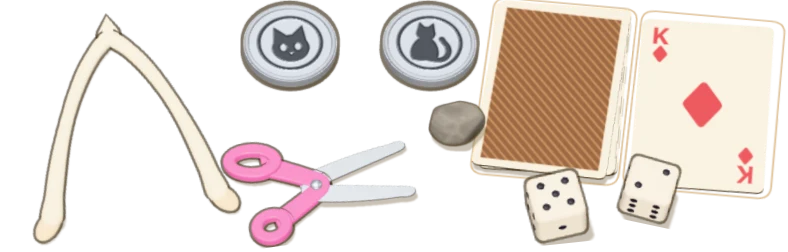
Three of the five are pure luck: the wishbone, heads or tails, and rock paper scissors. No skill will save you there, and none is needed. In higher or lower and dice rolls, playing the odds pays, and with no clock you can think those two through.
How it plays
- The five games come one at a time, in order:
- Wishbone: pull a side. If your half keeps the top, it pays 20.
- Heads or tails: two coins. Call the first one right for 20.
- Rock paper scissors: three throws against the day's three. A tie counts as half a win.
- Higher or lower: four calls on whether the next card is higher or lower, 20 for each one right.
- Dice rolls: five dice and up to three rolls, keeping the ones you like.
- Call the first coin right, and you can stay at 20 or go double or nothing on the second for 40. Call it wrong, and the second coin is a second chance, for 10.
- The dice pay the best pattern they make, from five of a kind at 100 down to the dice added up and doubled.
- Each game pays more than the last: up to 20, 40, 60, 80, and 100. The pot is full at 300.
A day, game by game
- 1 up to 20· Wishbone
- 2 up to 40· Heads or tails
- 3 up to 60· Rock paper scissors
- 4 up to 80· Higher or lower
- 5 up to 100· Dice rolls
Wishbone
Pure luck. Pull a side. The half with the top wins 20.
- 1 0· Wishbone
- 2 40· Heads or tails
- 3 30· Rock paper scissors
- 4 up to 80· Higher or lower
- 5 up to 100· Dice rolls
Higher or lower · call 1 of 4
Play the odds. 20 for each right call. Ace is low, king is high, and the next card is never this one's rank.
The card showing is a 4. In the deck: 36 higher cards and 12 lower.
Five games, one at a time. First, pull a side of the wishbone
The how-to has the rest: how the points work, and what each scoring tier takes.
Where it comes from
The five are familiar games of chance, tied together by their numbers. Each one is numbered by what it counts: one pull, two coins, three throws, four calls, and five dice. Its first name, Odds and Ends, lasted less than a day. Pot Luck is like the supper: you take what comes.
The idea started out silly: a daily game of rock paper scissors and nothing else. Then it grew into a game about managing risk and playing the probabilities, with a little bit of dopamine every time a guess comes in.
A coin toss and rock paper scissors were my first examples, and an early rule cut them both for being pure guesses, with nothing to decide. I dropped the rule and kept them. The test moved to the whole day instead: playing the odds where they pay has to outscore guessing on most days. In the game's own simulation, guessing came out ahead on fewer than one day in five.
What sets it apart
- Everyone gets the same luck. Every flip, throw, card, and die is drawn before the day begins, so a friend's pot and yours come from the same coins and the same dice.
- Judged against its own day. Your scoring tier comes from your pot against 1,000 random plays of the same day. Beat half of them for Jam, 3 in 4 for Cat, and 9 in 10 for Wow. So the points you need move with the day: kind dice raise them, and stingy ones lower them.
- The games climb. The three of pure chance come first and are worth 120 between them. Higher or lower and dice rolls, where the odds pay, are worth 180.
- The board does the counting. In higher or lower it shows how many cards left in the deck are higher and lower than the one showing. In dice rolls it lights up the pattern your dice make, and what it pays.
- Toys on a table. Each game is played with its own toys on a table drawn in 3D: a wishbone, two coins, a pebble with paper and scissors, a deck of cards, and five dice.
Play it
Pot Luck Play the odds in five quick games PlayNew luck goes up every day at midnight, New York time, the same for everyone, and a day takes a couple of minutes. The strategy guide works out where the odds pay, and how often luck alone reaches each scoring tier.